Secure AI scribes for New Zealand general practice: what to know

Kia ora. If you’re a GP, nurse practitioner or specialist anywhere in Aotearoa, you already know the shape of the problem: fifteen-minute consults that need twenty-five, inboxes that refill faster than they empty, and notes finished on the couch at nine o’clock because there was no gap in the day to write them properly. General practice in New Zealand is stretched — fewer hands, more complexity, and the documentation still has to be done right, because the record is what everything else stands on.
“She’ll be right” has never been a documentation standard. When notes are rushed, incomplete or inconsistent, risk grows for everyone — the patient, the practice, and the clinician whose name is on the record. An AI medical scribe is a practical way to ease that pressure: it drafts the note in the background while you stay focused on the person in front of you.
Akoua is a private AI medical scribe, and as of this week it is open to New Zealand clinicians. It is a documentation aid, not a diagnostic or clinical decision-support tool — see our responsible use statement. And the bit your privacy officer will want up front: your patients’ audio is processed in Australia and the clinical record is stored in Sydney — one hop across the ditch, no onward connections.
The documentation squeeze in New Zealand practice
The pressure shows up the same way in an Auckland group practice, a Wellington specialist room, or a two-GP clinic on the West Coast. Notes scatter across templates and personal styles. Clinical reasoning gets abbreviated to the point of vanishing. Problem lists and medication histories drift. When care is shared — GP, practice nurse, after-hours, hospital outpatients — it can be genuinely hard to reconstruct what was decided and why.
Rural and provincial practice adds its own layer: bigger books, more locums, and long stretches where you are the continuity. The workarounds all cost something. Typing during the consult means talking to a screen. Dictation tools need cleaning up line by line. Offshore scribe services raise exactly the questions New Zealand practices are rightly trained to ask: where did that audio go, who can hear it, and under which country’s rules?
And behind it sits the paperwork no scribe invented: ACC forms, referrals into a stretched system, and the standing expectation — from your college, your PHO, and any Cornerstone assessor — that the record be complete, contemporaneous and clear. The gap between best-practice documentation and what a stretched clinician can produce alone, every day, is real.
What “secure” should mean before you let AI into the room
If an AI system is going to listen to clinical conversations, security and privacy cannot be an afterthought. The Privacy Act 2020 and the Health Information Privacy Code ask blunt questions of your practice — especially about health information crossing the border — and any scribe you adopt becomes part of your answer. You should be able to tell a patient, in plain language, with exactly where their data sits, who processes it, and how it is protected. If a vendor can’t give you that answer in one breath, that is the answer.
Akoua’s answer is specific rather than general. New Zealand organisations run our AU Sovereign profile: audio is transcribed and notes are drafted on Australian infrastructure over private links, and your clinical record is stored in Sydney, handled in line with the Australian Privacy Principles (Privacy Act 1988 Cth). Not the United States, not a patchwork of global services — one named country, one sea away, disclosed on every note. Alongside it: AES-256 encryption at rest and in transit, an append-only audit log, passkey sign-in, and audio deleted by default — kept encrypted only while you review, deleted the moment you confirm the note, with a hard 7-day ceiling on abandoned drafts. Your patients’ clinical data is never used to train models, not by Akoua and not by our providers. The full picture is in privacy by design.
We’d also rather name what a hosting decision doesn’t settle. In Aotearoa, questions about where health data lives can carry more than legal weight — for some patients and practices they are questions of data sovereignty in a deeper sense. We won’t pretend a server region answers those. What we can do is make sure the conversation starts from facts: you can tell a patient exactly where their data goes, watch the deletion happen, and hand them a receipt for it.
How ambient AI changes the consultation
Ambient AI sits quietly in the background of a consult, listening to the natural flow of conversation and turning it into structured notes. No rigid scripting, no constant typing. You face your patient, listen properly, and ask the follow-up question without rehearsing the note in your head.
A typical workflow looks like this:
- You explain consent and privacy to the patient in clear, simple terms
- With agreement, secure audio capture starts while you talk as normal
- The scribe drafts a structured note — history, examination, assessment and plan
- You review, edit and confirm the note before anything is saved
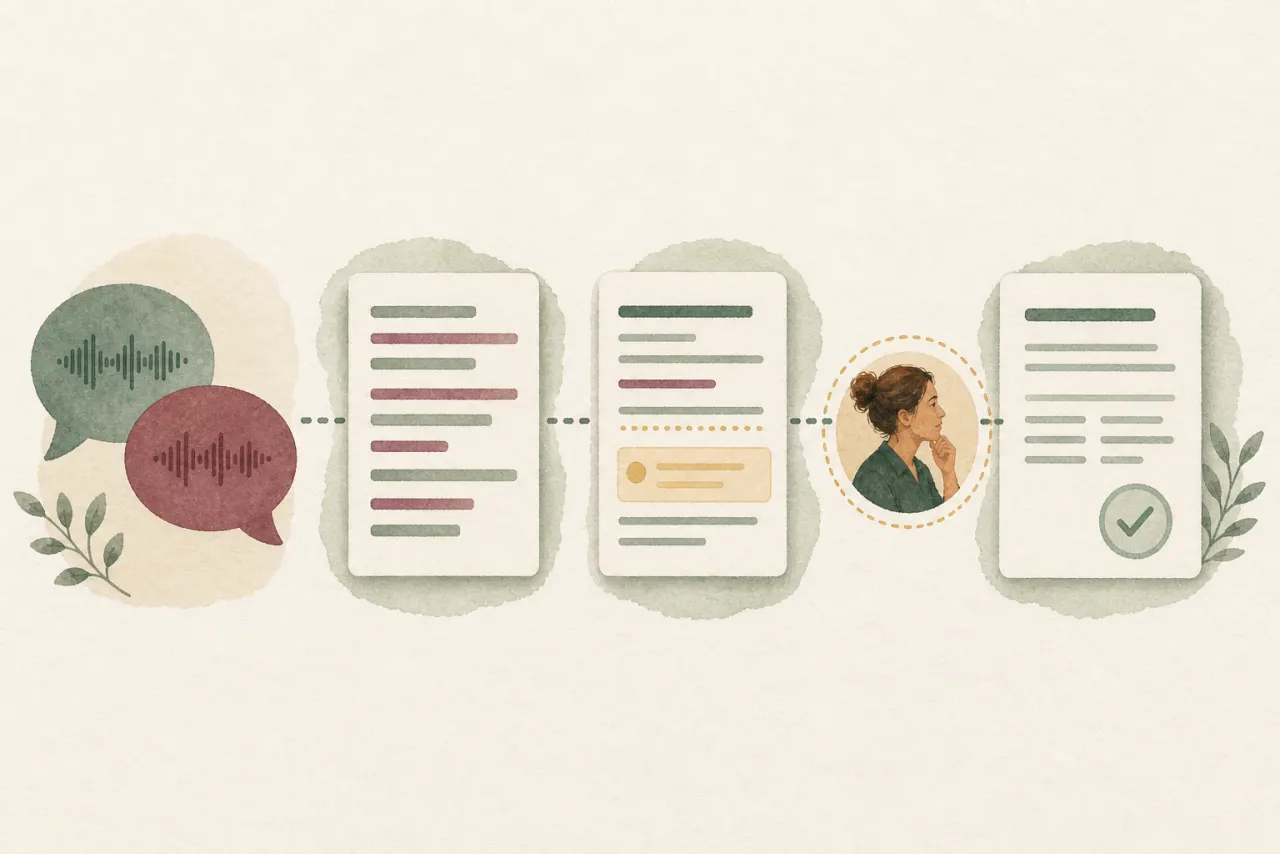
That last step is not a formality. Nothing in Akoua is committed on the model’s own: every draft requires your explicit review and confirmation, anything not said is marked [ not stated ] rather than filled in with something plausible, and anything it wasn’t sure it heard is flagged for your eye instead of smoothed over. A fluent error is the one you sign without noticing — the whole product is built around not letting that happen.
The honest bit: what’s Australian about it today
Akoua’s clinical tuning is Australian. The drug vocabulary is PBS/AMH and the letters are RACGP-aware; MBS billing hints are Australian-only, so New Zealand organisations don’t see them at all — better no billing hint than one from the wrong country’s schedule. A good deal of that carries across the Tasman untouched — the transcription, the flags, the grounding of every statement to what was actually said, the letters and tasks — because a consult is a consult on either side of the ditch. But we have not built New Zealand-specific vocabulary or billing: no NZ Formulary, no Read Codes, and our speech benchmarks are built on synthetic Australian-accent consult audio. We haven’t published New Zealand-accent numbers, and we won’t imply them.
If that trade-off doesn’t work for your practice, we’d rather you knew before you signed up. If it does — and for many practices the privacy answer and the note quality are the point — then sign up knowing exactly what you’re getting, and tell us the moment something New Zealand-shaped trips it up. That feedback lands with the people who build it, the doctor included, and it is precisely what decides what gets built next.
Questions worth asking any scribe vendor
Not every AI scribe is built with New Zealand practice in mind. Before adopting one, ask directly:
- Where is clinical data stored and processed, exactly — which countries, named
- Who inside and outside the organisation can access it, and is that access logged somewhere that can’t be edited
- How long are audio and text retained, and can you prove deletion rather than assume it
- Does the practice keep ownership of the notes, and can they be exported in standard formats
- What does the tool do when it is unsure — and can you see it
Then weigh workflow fit: mixed in-person and telehealth consults, multi-clinician and multi-site setups, and whether the tool works on the devices your practice actually uses. Akoua runs on the web, Windows, Mac, iPhone and Apple Watch, and Android, with one account across all of them.
Putting a scribe to work in your practice
Adopting an AI scribe works best as a staged change, not a big bang. Start with one or two interested clinicians, agree what success looks like — evenings back, note completeness, how patients respond to the consent conversation — and review together as a practice. Set shared documentation standards, make quick review-and-confirm a habit, and sample notes periodically for quality. As ACC processes, telehealth arrangements and privacy expectations shift, your scribe should shift with them — and say so plainly when it hasn’t yet.

Where Akoua is up to
Akoua is open in New Zealand now — same product and same founders pricing as Australia, A$79/month billed in AUD, with GST applying to Australian customers only. If documentation is costing your evenings and you want a scribe that shows you what it wasn’t sure of instead of guessing, sign up, read how our sovereignty profiles work, or get in touch if you’d rather talk it through first. Nau mai, haere mai.