Secure AI scribes for Australian clinics: what to know

Clinicians across Australia are spending far too many hours on admin that has nothing to do with why they went into medicine. Notes are finished late at night, documentation is squeezed between consults, and important details are held in memory because there is no time to write them down properly. That pattern is exhausting, and it quietly chips away at patient care.
High-quality documentation is not optional. It underpins patient safety and continuity of care, and it is what a record has to stand on later. When notes are rushed, incomplete, or inconsistent, risk grows for everyone. An AI medical scribe offers a practical way to ease that pressure, drafting notes in the background while clinicians stay focused on patients.
Akoua is a private, Australian AI medical scribe, built for Australian practice: PBS/AMH drug vocabulary, MBS billing hints and RACGP-aware letters, with Australian data residency for clinical data. It is a documentation aid, not a diagnostic or clinical decision-support tool — see our responsible use statement. It is open now — sign up with founders pricing.
The documentation dilemma facing Australian clinics
Across general practice, specialist rooms and allied health, documentation pressure shows up in familiar ways. Notes are scattered across different templates and styles, important clinical reasoning is left out, and problem lists and medication histories drift out of date. When multiple clinicians share care, it can be hard to reconstruct what was decided, what was discussed with the patient, and why a particular plan was chosen.
Current workarounds often create their own headaches. Manual typing slows consults and pushes work after hours. Paper notes are hard to share, easy to misplace, and difficult to audit. Generic dictation tools need cleaning up line by line, and overseas scribe services raise questions about data handling, accuracy of medical language, and extra time spent reviewing their work.
These documentation issues sit behind larger practice challenges. When clinicians are overloaded with admin, appointments feel rushed and the working day stretches. Expectations around telehealth and mixed care models add more complexity, as notes need to cover in-person and remote consults with the same level of detail. There is a clear gap between what best-practice documentation looks like and what an already stretched clinician can realistically produce on their own every single day.
What makes an AI medical scribe secure
If an AI system is going to listen to clinical conversations, security and privacy cannot be an afterthought. For Australian healthcare, security should mean that clinical data is stored in Australia, protected with strong encryption in transit and at rest, with clear access controls and an audit trail that shows who viewed or edited what. It should be possible to explain to a patient, in plain language, where their data sits and how it is protected.
Any scribe used here also needs to fit the Australian Privacy Principles and the health-records law that applies to you. AI-assisted notes still belong to the clinician. That means the system must support careful human review, clear authorship, and a reliable way to correct errors.
Local hosting matters. Keeping data within Australia reduces cross-border data risk, provides clearer legal jurisdiction, and fits Australian health data frameworks and community expectations.
Akoua’s approach is specific rather than general. Clinical data is handled in line with the Australian Privacy Principles (Privacy Act 1988 Cth), with Australian data residency, AES-256 encryption at rest and in transit, an append-only audit log and passkey sign-in. Audio is deleted by default — kept encrypted only while you review, deleted the moment you confirm the note, with a hard 7-day ceiling on abandoned drafts. Your patients’ clinical data is never used to train models, not by Akoua and not by our providers. There is more detail on all of it in privacy by design.
How ambient AI changes the consultation
Ambient AI sits quietly in the background of a consult, listening to the natural flow of conversation and turning it into structured notes. There is no need for rigid scripting or constant typing. Clinicians can face their patients, listen properly, and ask follow-up questions without worrying they will forget key details later.
A typical workflow looks like this:
- The clinician explains consent and privacy to the patient in clear, simple terms
- With agreement, secure audio capture starts while they talk as normal
- The scribe drafts a structured note — history, examination, assessment and plan
- The clinician reviews, edits, and confirms the note before anything is saved
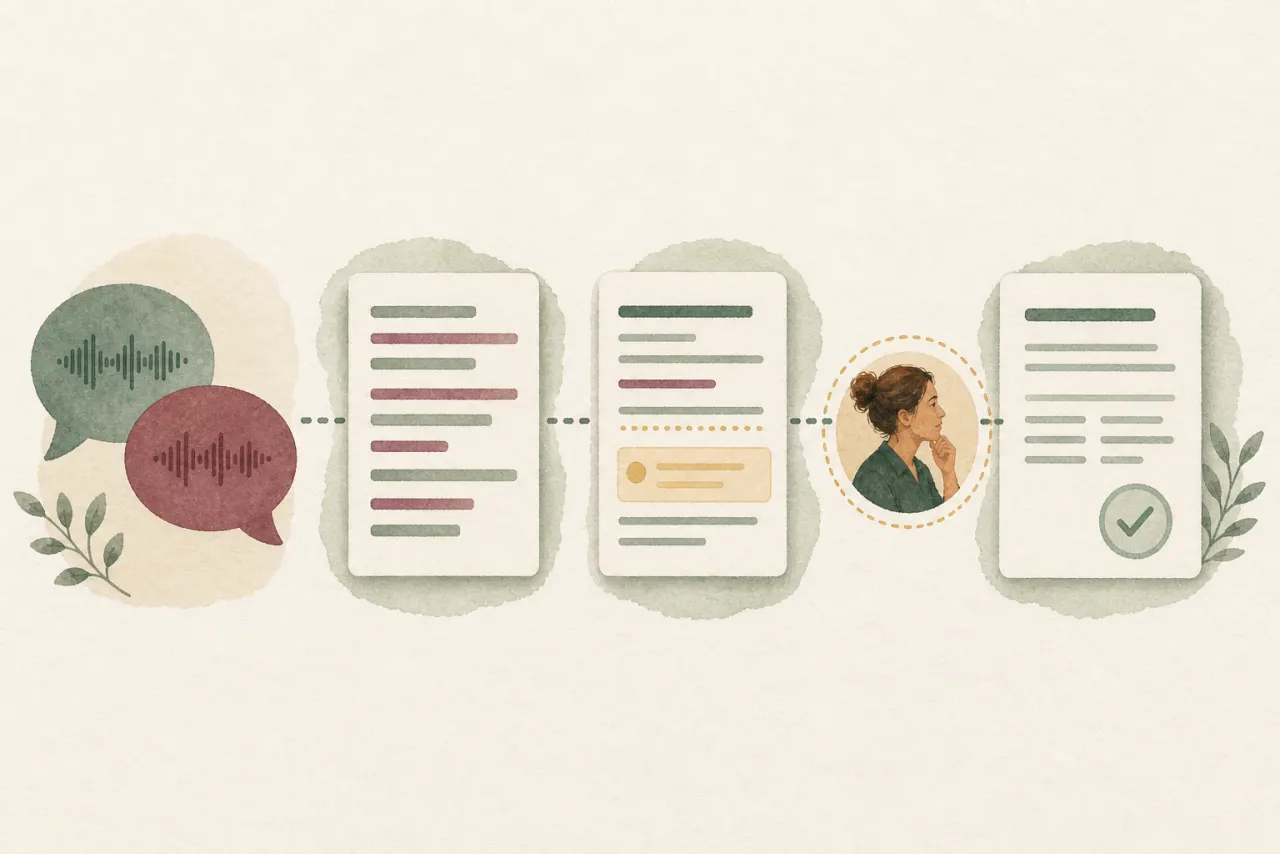
That last step is not a formality. In Akoua nothing is committed on the model’s own: every draft requires your explicit review and confirmation, anything not said is marked [ not stated ] rather than filled in with something plausible, and anything it wasn’t sure it heard is flagged for your eye instead of smoothed over.
For patients, the difference is visible. They see their clinician looking at them rather than at a screen. When privacy safeguards are explained rather than buried in a policy, there is something concrete to point to. Clearer documentation also supports better sharing of information between GPs, specialists and allied health teams, which reduces how often patients repeat their history.
Questions worth asking before you choose one
Not every AI scribe is built with Australian clinics in mind. Before adopting one, it helps to ask direct questions:
- Where is clinical data stored, exactly, and is it kept within Australia
- Who inside and outside the organisation can access that data, and under what conditions
- How long are audio and text retained, and what happens to them if the clinic changes systems
- Does the clinic retain ownership of the notes, and can they be exported in standard formats
Clinical quality matters just as much as security. It is worth understanding how the system has been adapted to Australian healthcare, how well it handles local accents and medical terminology, and how often clinicians find themselves rewriting rather than lightly editing. Ask what the tool does when it is unsure — a scribe that always sounds confident is not the same as one that is always right, and a fluent error is the one you sign without noticing.
Workflow fit is another key area. A scribe should support the way the clinic already works, including mixed in-person and telehealth consults, and multi-clinician or multi-site setups. Finally, ask about governance and transparency. Patients should be able to understand how AI supports their care, and clinics should be confident the platform can keep pace with changing regulations and expectations.
Putting an AI scribe to work in your clinic
Adopting an AI scribe works best as a staged change rather than a sudden switch for everyone. Start with a small group of interested clinicians, agree on what success looks like, and review together. Those measures might include changes in after-hours work, or improvements in note completeness and clarity. Patient feedback matters too, especially how people feel about consent, privacy and the overall consultation experience.
Change management is where the human side counts. Clinicians need time and support to learn a new workflow, to ask questions, and to voice scepticism. Practices often find it useful to:
- Set shared documentation standards and templates
- Encourage quick review and sign-off as a habit
- Periodically sample notes for quality and consistency
- Refine preferences so the output aligns with clinic policy
As Medicare rules, telehealth arrangements and privacy expectations shift, a scribing tool should adapt with them.

Where Akoua is up to
Akoua is open now. If documentation is costing your evenings and you want a scribe that shows you what it wasn’t sure of instead of guessing, sign up — or get in touch if you would rather talk it through first. Questions reach the people who build it, the doctor included.